

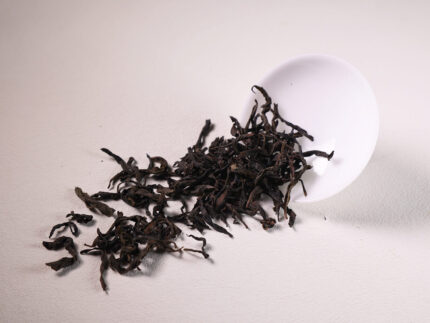


















Why Yancha Needs Roasting, Whether Heavier Roast Is Better,
and How to Find the Roast Style That Suits You
> Quick Answer
Roasting is one of the most misunderstood parts of Wuyi rock tea.
Many people assume roasting is simply about adding aroma or making a tea taste stronger. In reality, most of a tea's character has already been formed before roasting begins.
Roasting doesn't create flavor. It completes flavor. The floral, fruity, and spicy notes associated with Yancha are largely developed during earlier processing stages. Roasting helps stabilize the tea, refine those flavors, and bring different aspects of the tea's personality into focus.
A heavier roast does not necessarily mean a better tea. The best roast is the one that allows a tea to express itself clearly.
In this article, we'll explore why Yancha is roasted, how traditional tea makers think about roast, what light, medium, and traditional roast actually mean, and how to choose the style that suits you.
A while ago, I received an email from a tea drinker who was shopping for Wuyi rock tea online.
She asked a question that I hear surprisingly often.
“When I look at Yancha product descriptions, I see terms like light roast, medium roast, and traditional roast. What do they actually mean? I’ve bought Rougui from different vendors, and even though they were all described as medium roast, they tasted completely different.”
Then she mentioned something else she had noticed. Some teas were described as needing time for the roast to settle. Others warned that the tea might “return green” if it wasn’t stored properly. What did that mean? Was it a flaw? Did it mean the tea would become bitter or unpleasant?
And why did roasting seem so much harder to understand than other aspects of tea processing?
Over the years, I’ve realized these are some of the most common questions among people exploring Wuyi rock tea for the first time. They come up in emails, tea groups, online discussions, and conversations around the tea table.
So let’s answer them properly.
Especially in recent years, as short videos and social media have become the main source of tea information for many drinkers, you’ve probably come across statements like:
- “Eight rounds of roasting create the best Yancha.”
- “The heavier the roast, the better the tea.”
- “Light roast is only for beginners.”
If those statements were true, understanding Yancha would be easy. We could simply rank teas according to roast level and assume that more fire automatically means higher quality.
But once you spend time in Wuyi Mountain, you quickly discover that roasting doesn’t work that way.
Unlike withering or oxidation, roasting isn’t a fixed formula with a universally correct answer. It is the final stage through which a rock tea expresses itself. It expresses the character of the cultivar, the understanding of the tea maker, and ultimately the unique identity of Yancha itself.
Roasting Was Not Originally Created to Add Flavor
Many tea drinkers assume that roasting exists simply to make tea more aromatic.
Historically, that wasn’t its primary purpose. Wuyi Mountain is a humid mountain region. Before modern transportation and climate-controlled storage, tea needed to survive long journeys from remote villages to distant markets. One of the earliest purposes of roasting was simply to reduce moisture and improve stability.
In other words, roasting began as a practical solution. Over time, however, tea makers discovered something more. Roasting didn’t simply preserve tea. It changed tea.
A properly roasted tea often became sweeter, rounder, more stable, and more expressive. Aromas became clearer, the liquor gained depth, and the overall drinking experience felt more harmonious.
Gradually, roasting evolved from a preservation technique into one of the defining crafts of Wuyi rock tea production.
That is why it is almost impossible to talk seriously about Yancha without talking about roast.
Not because roast is the goal.
But because roast has become one of the most important ways Yancha expresses itself.
Roasting Doesn't Create Flavor. It Completes Flavor.
To understand roast, we need to go one step earlier in the process.
Most tea drinkers have heard of zuoqing (做青), the stage responsible for many of the floral, fruity, honey-like, and spicy characteristics associated with Wuyi rock tea.
What many people don’t realize is that by the time the tea reaches the maocha (毛茶) stage, much of its essential personality already exists.
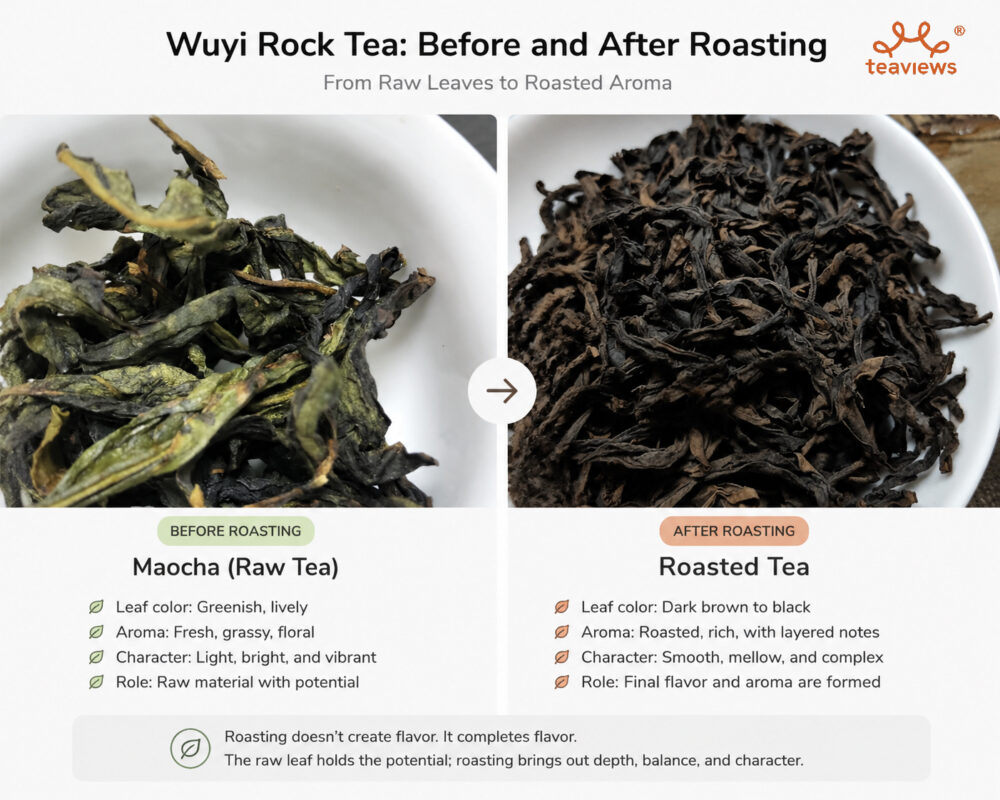
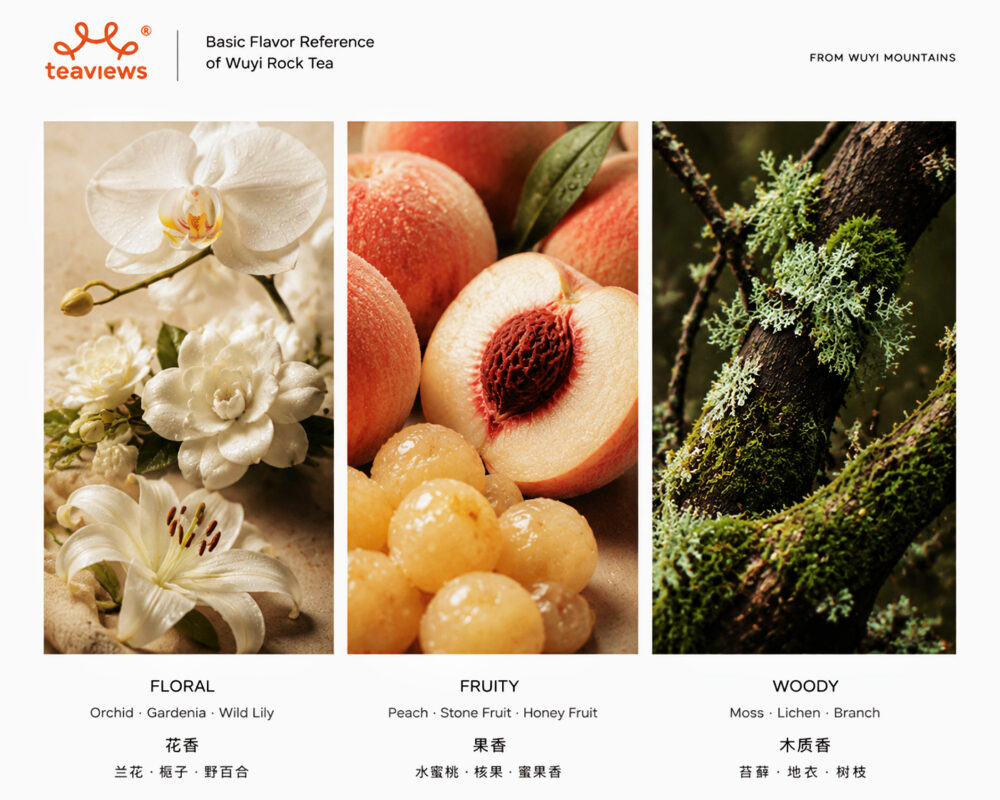
The orchid notes, peach-like aromas, floral fragrances, cinnamon character, and creamy sweetness often associated with Wuyi rock tea all begin to take shape here.
By the time the tea reaches the maocha stage, its fundamental personality is already present.
I’ve always been reminded of traditional film photography.
The moment you press the shutter, the image already exists. The composition is there. The subject is there.
Yet the photograph still needs to be developed before you can fully see it.
For Yancha, roasting feels very similar.
A skilled tea maker is not trying to create an entirely new tea. Instead, they are working with something that already exists, helping it become clearer, more complete, and more balanced. Sometimes roasting highlights a tea’s strengths. Sometimes it softens rough edges left behind during earlier processing. Sometimes it simply allows the tea to settle into itself.
This is why the same cultivar can display dramatically different personalities when roasted in different ways.
In many respects, zuoqing determines what a tea can become. Roasting determines how that tea eventually introduces itself.
How Traditional Wuyi Tea Makers Understand Roasting
One of the most respected figures in modern Wuyi tea roasting, Yao Yueming, summarized the purpose of roasting with eight Chinese characters:
整合、化异、提气、促醇
The first time I encountered these words, I found them somewhat abstract.
Over time, however, I realized they capture the essence of traditional Wuyi roasting remarkably well.
Integration (整合) refers to bringing different elements of a tea into harmony. This may include balancing differences created by blending lots, variations in growing environments, or inconsistencies within a batch.
Refinement (化异) means removing distracting aromas, green notes, and unwanted flavors while improving stability and storage potential.
Elevation (提气) refers to clarifying and strengthening the tea’s aromatic identity so that its personality becomes easier to recognize and remember.
Mellowing (促醇) focuses on developing sweetness, body, texture, and depth in the liquor.
What’s interesting is that none of these goals are really about making a tea taste more roasted.
They are about helping the tea become more complete.
This is why experienced tea makers rarely begin by asking how much roast a tea should receive.
They spend far more time trying to understand the tea itself. Only then do they decide what kind of fire it needs.
In China, tea makers often use a simple phrase:
“Look at the tea before making the tea.”
The same philosophy applies to roasting.
What Is the Difference Between Light Roast, Medium Roast, and Traditional Roast?
Generally speaking, the differences between roast styles come from a combination of temperature, duration, roasting cycles, and the tea maker’s intended outcome.
Unlike zuoqing, roasting does not determine oxidation in the same way earlier processing stages do. Most of that work has already been completed. Roasting works on top of that foundation, shaping how aroma, sweetness, texture, minerality, and structure eventually appear in the cup.
From a tea maker’s perspective, roasting is less about following a fixed temperature chart and more about responding to a tea that is constantly changing.
The challenge is knowing when enough has become enough.
|
Roast Level |
Typical Temperature Range |
Typical Duration |
Common Characteristics |
Flavor Profile |
Liquor Color |
|---|---|---|---|---|---|
|
Light Roast |
80–100°C |
4–8 hours |
Floral-focused |
Orchid, gardenia, fresh floral notes |
Golden yellow to amber |
|
Medium Roast |
100–120°C |
8–12 hours |
Balanced expression |
Floral notes, fruit sweetness, creamy sweetness, mineral character |
Amber to reddish amber |
|
Traditional Roast |
120–150°C |
12–24 hours |
Traditional style |
Dried fruit, wood, caramel sweetness, charcoal, medicinal notes |
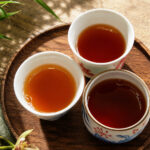
Deep amber to dark reddish brown |
Different tea makers may use different temperatures and durations depending on cultivar, moisture content, roasting style, and desired outcome.
Does More Roasting Mean Better Tea?
This is probably the question I wanted to answer most when writing this article.
The short answer is no.
Roasting has a purpose. Once that purpose has been achieved, additional roasting does not automatically improve the tea.
Everything returns to the four goals described earlier: integration, refinement, elevation, and mellowing.
Yet many tea drinkers still assume that heavier roast must indicate higher quality. Some even use the number of roasting cycles as a shortcut for judging a tea.
The reality is far less dramatic.
A tea made from ordinary material does not become exceptional simply because it receives more fire. In fact, excessive roasting can gradually strip away aroma, sweetness, and complexity.
One of the most respected traditional Wuyi tea makers I have learned from is Liu Dexi, a recognized inheritor of traditional Wuyi tea-making techniques. He once explained that his teachers trained him with a surprisingly strict standard: achieve the desired result in a single roast whenever possible.
This wasn’t about saving effort.
Quite the opposite.
A successful single roast reflects accurate judgment during earlier processing stages, a deep understanding of the tea itself, and precise control over heat.
Every additional roast means handling the leaves again. The leaves are turned, moved, and exposed to more variables. Breakage increases. Processing losses increase. The chances of introducing new problems increase as well.
For many traditional tea makers, achieving the desired result in one roast is not a shortcut. It is a sign of craftsmanship.
Different teas also respond differently to heat.
The pear-like sweetness of Fo Shou often shines under a lighter roast. Tie Luo Han, on the other hand, frequently benefits from a more traditional roast that brings forward its mineral depth and herbal character.
This is one reason experienced tea makers rarely discuss roast level in isolation.They discuss the relationship between the tea and the fire.
Good roasting is not about maximizing fire. It is about helping each tea reach the expression that suits it best.
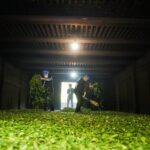
Inside a Wuyi Roasting Room
If you’ve never visited a roasting room during tea season, it’s easy to imagine it as a peaceful place.
In some ways, it is.
The room is warm. The air carries the scent of tea. On a cool mountain evening, it can feel surprisingly comfortable.
But for the tea makers inside, it often feels more like a battlefield than a retreat.
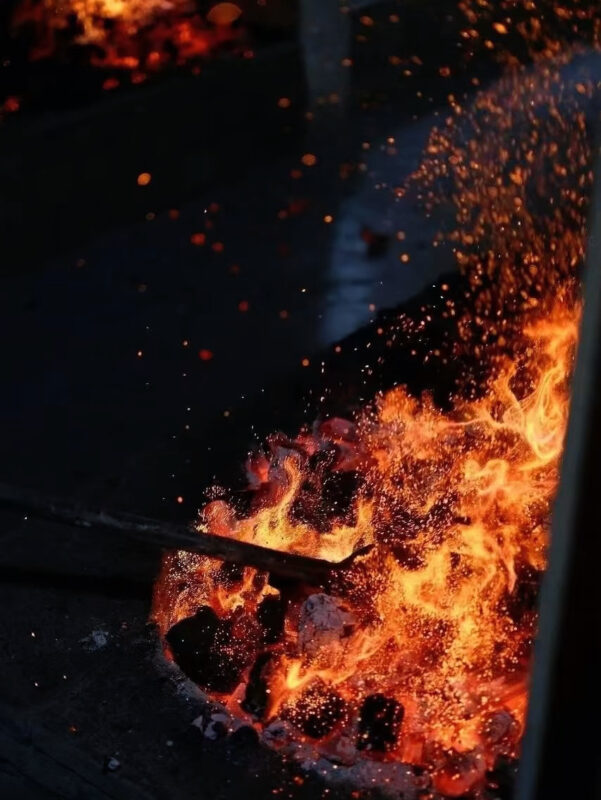
Dozens of batches may be changing at the same time. Moisture, temperature, and aroma are constantly shifting. A decision that seems small in the moment can influence months of work.
Sometimes the difference between success and disappointment is measured in minutes.
During roasting season, many tea makers sleep lightly, waking through the night to check on a batch that may still need attention. A roasting room may contain more than a dozen roasting pits and hundreds of kilograms of tea, all changing simultaneously.
When people talk about roasting, they often focus on flavor.
What they don’t always see is the judgment, patience, responsibility, and pressure hidden behind that flavor.
A mistake doesn’t simply ruin a cup of tea.
It can affect an entire year’s work.
Which Roast Level Is Best for Beginners?
For most tea drinkers, choosing a roast level is less about expertise and more about personal preference. A useful place to start is by looking at the teas you already enjoy.
|
If You Enjoy... |
You May Prefer... |
|---|---|
|
Jasmine tea |
Light Roast Yancha |
|
Green oolong |
Light Roast Yancha |
|
Highly floral teas |
Light Roast Yancha |
|
Balanced tea with aroma and body |
Medium Roast Yancha |
|
Exploring Yancha for the first time |
Medium Roast Yancha |
|
Whisky |
Traditional Roast Yancha |
|
Dark chocolate |
Traditional Roast Yancha |
|
Aged tea |
Traditional Roast Yancha |
If your goal is simply to understand why Yancha feels different from other oolong teas, I usually recommend beginning with a medium roast.
-
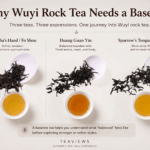
 Yancha Baseline Set – Huang Guan Yin, Que She & Fo Shou
Rated 4.00 out of 5$37.00
Yancha Baseline Set – Huang Guan Yin, Que She & Fo Shou
Rated 4.00 out of 5$37.00
It tends to show several aspects of Yancha at the same time: floral aromas, sweetness, minerality, texture, and roast influence, all within a relatively balanced framework.
The most important thing to remember is that there is no universally best roast level.
There is only the roast level that suits your own preferences.
How Should Different Roast Levels Be Brewed?
Light roast Yancha often emphasizes floral aromas.
Many people assume lower temperatures are necessary, but aromatic compounds in Yancha generally respond well to heat. I usually use water close to boiling and keep the first few infusions short to preserve freshness and clarity.
Medium roast Yancha is often more forgiving.
Water temperatures between 95°C and 100°C generally work well. Faster pours tend to emphasize aroma, while slightly slower pours can bring out sweetness and mineral texture.
Traditional roast Yancha should not be treated gently simply because it is heavily roasted.
These teas often need time to open and reveal themselves. Boiling water is usually appropriate, and many traditional roast teas become more expressive in later infusions rather than the first few cups.
In practice, I find that brewing style matters just as much as roast level. A lightly roasted tea brewed aggressively can feel completely different from the same tea brewed gently.
Why Freshly Roasted Yancha Is Not Always at Its Best
Freshly roasted tea is not always ready to drink.
Heat moves through tea gradually. Immediately after roasting, some teas may display strong charcoal notes or feel sharp and unsettled.
This does not necessarily mean the tea is flawed.
Sometimes it simply needs time.
As the tea rests, roasted notes gradually integrate with floral, fruity, and mineral characteristics. What initially feels disconnected may become balanced and harmonious several weeks later.
Many tea makers intentionally allow tea to rest before releasing it.
This is also why a tea produced last year may actually be drinking beautifully today. Age does not always mean the tea is past its peak. In many cases, it simply means the tea has had time to settle.
I’ve occasionally received messages from tea drinkers who were disappointed by a newly purchased tea. Then a month later they wrote again to say it had become one of their favorites.
Tea changes.
Sometimes patience is part of the process.
What Does Returning Green Mean?
The opposite phenomenon is known as returning green.(返青)
When tea absorbs excessive moisture from the environment, some of the green, grassy, or unsettled notes that roasting was intended to remove may begin to reappear.
Tea drinkers often describe returning green as a damp plant-like aroma that feels out of place within the tea’s overall profile.
This doesn’t necessarily mean the tea is ruined.
In many cases, it simply means moisture has disrupted the balance the tea maker worked to create.
That is why storage matters.
For Yancha, the principles are simple:
- Keep the tea sealed.
- Protect it from humidity.
- Avoid direct sunlight.
- Keep it away from strong odors.
In my experience, individually sealed packets usually preserve aroma longer than large containers that are repeatedly opened and exposed to air.
Final Thoughts
When people first encounter Wuyi rock tea, they often focus on the roast.After drinking Yancha for a while, many discover that roast is not the main character.
The tea is.
Roasting simply helps the tea find its most balanced expression.
The more time I spend with tea, the more I feel that we are not very different.
Roasting is a process of bringing different elements into harmony. Tea makers spend years learning how to guide that process without forcing it.
Perhaps our own lives work in a similar way. The more open we become to different styles, different experiences, and different ways of understanding tea, the more variety and surprise we discover along the way.
That, to me, is one of the most rewarding parts of drinking Yancha.
Frequently Asked Questions
Why do two medium-roast Rougui teas taste completely different?
Because roast is only one part of the final flavor. Cultivar selection, mountain origin, processing decisions, oxidation level, and roasting style all influence the outcome.
Why is Wuyi rock tea roasted?
Historically, roasting helped preserve tea by reducing moisture. Over time, tea makers discovered that roasting could also improve aroma, sweetness, texture, and stability.
Does more roasting mean better tea?
No. The best roast is the one that allows a tea to express its character most clearly. More roasting does not automatically mean higher quality.
Is light roast Yancha more floral?
Generally, yes. Light roast teas often preserve more floral and high-aroma characteristics, although cultivar and processing style also play important roles.
Can roast level indicate quality?
Not reliably. Roast level describes a style rather than a quality grade.
What is roast settling?
Roast settling refers to the period after roasting when roast notes integrate with the tea's natural aromas and flavors.
How long should roasted Yancha rest?
It depends on the tea and the roast level. Some teas settle within a few weeks, while others continue improving over several months.
What is returning green?
Returning green occurs when tea absorbs moisture and begins to show green or grassy characteristics again.
How should I store Wuyi rock tea?
Store it in a sealed, dry, odor-free environment away from direct sunlight and excessive humidity.
What roast level is best for beginners?
For most people, medium roast Yancha is the easiest starting point because it balances aroma, sweetness, minerality, texture, and roast influence.