




















Why Tea Feels Too Strong After Eating — and How to Brew It More Gently

Many people do not stop enjoying tea after meals because they suddenly dislike tea. What often happens is much more specific: the same tea that feels balanced at another time can feel too strong, too abrupt, or simply less pleasant after eating.
That does not always mean the tea is poor, and it does not always mean the tea category is wrong. More often, the tasting context has changed. After a meal, tea does not arrive in a neutral mouth or a neutral body. Oil, spice, sweetness, and acidity may still be shaping the palate. At the same time, the stomach and intestines are already in active digestive motion. If the tea is brewed with the same strength you would use at another time, it may feel heavier, sharper, or more tiring than expected. Sometimes the tea does not feel lively after a meal — it feels like it is pushing forward too quickly.
The tea has not changed. The tasting context has. After a meal, intensity is often what rises first. That also helps explain why tea feels settling after meals.
Why the Same Tea Can Feel Different After Eating
One important reason is simple: after eating, the mouth is no longer neutral.
Foods rich in oil, chili, sweetness, salt, or acidity can change how the palate receives the next thing that comes in. Some of the qualities that make a tea attractive in a quieter moment — sweetness, fragrance, small layers, delicate lift — may feel less obvious right after a meal. At the same time, bitterness, astringency, thickness, or roast may come forward more quickly.
In other words, the tea has not necessarily changed. The context of tasting has.
The second reason is physical. After a meal, the body is already in a more active digestive state. Stomach acid, digestive enzymes, intestinal movement, and the pressure of food being broken down all make this period different from drinking tea on an emptier stomach or in a calmer moment of the day. If a tea is already dense, brisk, or highly concentrated, the body may register it less as flavor and more as intensity.
That is why a tea that feels vivid and satisfying in one setting may feel too strong in another.
After Eating, Intensity Often Gets Amplified
After a meal, not every part of tea becomes equally noticeable.
What often gets amplified first is intensity: bitterness, astringency, roast pressure, thickness, and the speed with which the tea seems to arrive in the body. What does not always become clearer is the sweeter or finer part of the tea. This is one reason some people feel disappointed by a tea after food. The tea may still have sweetness or fragrance, but those qualities are harder to notice when the palate is still occupied and the digestive system is already busy.
This is also why people sometimes think a tea is too much after eating, even when the tea itself is not especially aggressive. What rises first may simply be the part of the cup that is least comfortable in that moment.
Why Waiting a Little Often Works Better
For many people, waiting around 30 minutes after a meal feels more comfortable than drinking tea immediately.
This does not apply only to tea. Right after eating, the stomach is already working with food and liquid at the same time. If another drink is added too early — especially a strong one — it can feel heavier or more disruptive than it would later.
That does not mean tea must never be drunk with or right after food. In many tea cultures, that obviously happens. But if your question is specifically about why tea feels too strong after eating, timing is one of the first things to adjust.
A short pause often changes the whole experience.
Often, the Problem Is Not the Tea — It Is the Brewing Match
When tea feels too strong after eating, many people immediately blame the tea itself. But very often, the mismatch is in the brewing.
A tea that feels balanced at another time may feel overly heavy after food if too much leaf is used, the first infusion is too long, high temperature is combined with a dense leaf ratio, or the tea is drunk too quickly, cup after cup.
This matters because post-meal tea does not need to prove its intensity. It needs to fit the moment.
The goal is not to flatten the tea until it becomes meaningless. The goal is to reduce unnecessary pressure in the cup, so the tea can still feel present without feeling forceful.
Many people respond to discomfort by making the tea stronger. That usually makes the experience worse.
If You Drink Tea Soon After Eating, Brew It Lighter Than Usual
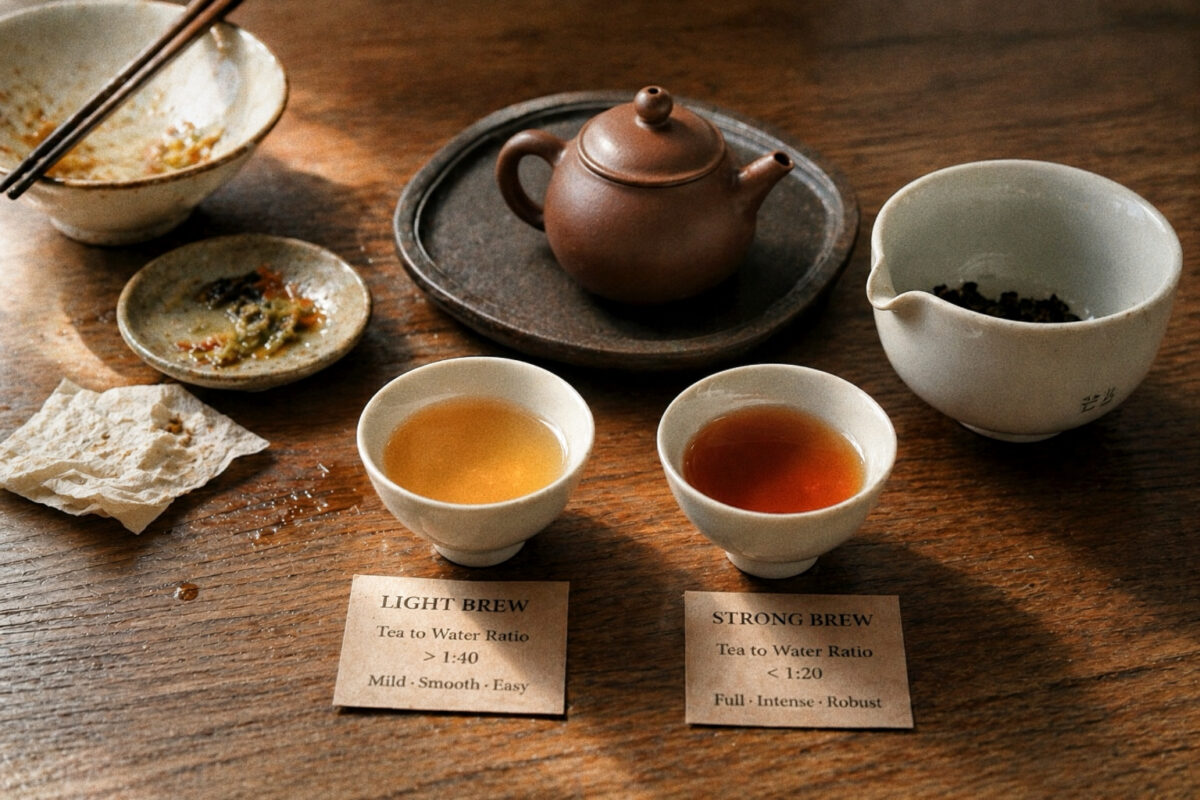
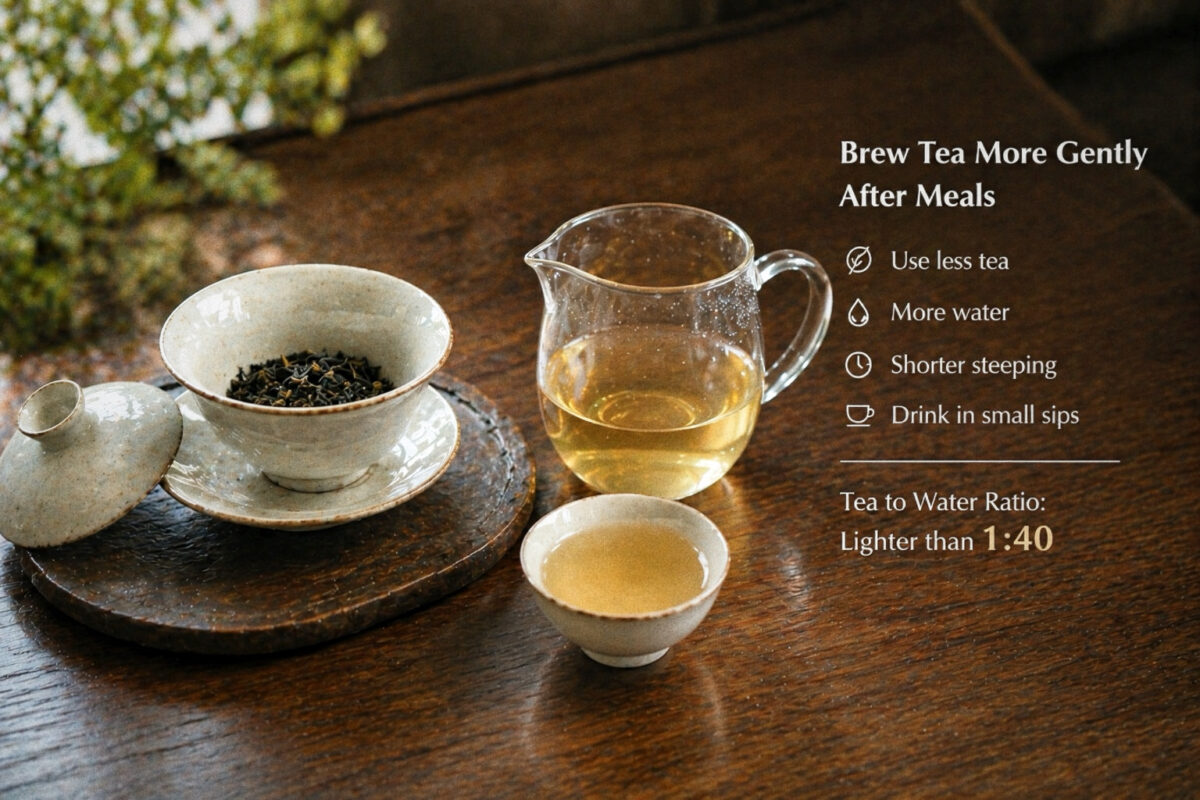
If you want tea soon after a meal, the simplest adjustment is to brew it lighter than usual. If you prefer a reference, keep the tea-to-water ratio lighter than about 1:40.
That means more than 40 parts water for 1 part tea. For 100ml of water, keep the leaf below about 2.5g. If you are brewing in a mug, pot, or larger vessel, simply use less tea than usual or add more water than usual.
This one change often makes a bigger difference than changing the tea itself.
A few more practical adjustments also help:
- shorten the first infusion
- do not chase thickness right away
- avoid trying to bring out more flavor in the first cups
- drink in small sips rather than several concentrated cups in quick succession
If you are not measuring anything, the simplest rule is this: use slightly less tea than usual, and stop the first steep earlier than you think.
What Usually Works Better After Eating
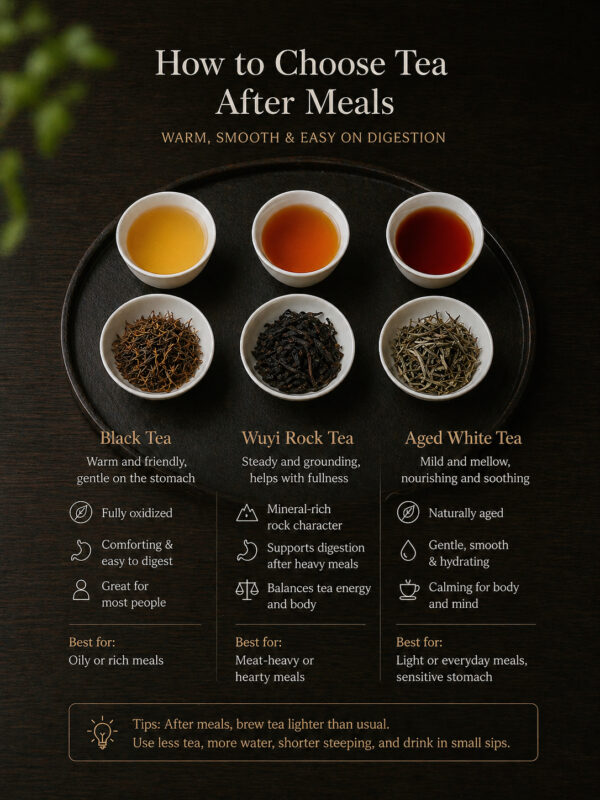
After meals, many people find it easier to drink teas that feel warmer, rounder, and less sharp in the cup.
That usually means looking less at the tea’s marketing category and more at its drinking profile.
What often works better is tea that feels warm, not iced; clear, not overly thick; aromatic, but not aggressively sharp; rounded, not strongly bitter; present, but not forceful.
From that perspective, a few tea styles often feel easier after meals.
Black tea
Black tea often feels rounder and more settled in the cup, especially when brewed with moderate strength. It tends to suit people who want warmth and continuity rather than lift and sharpness.
Wuyi rock tea
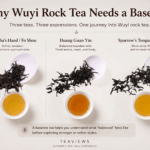
When brewed gently, Wuyi rock tea can work well after meals because roast and structure often make it feel warming and grounded rather than fresh and piercing. But the key here is still brewing: the same yancha can feel excellent or exhausting depending on how hard it is pushed. If this is the profile you tend to prefer after meals, you can explore our Wuyi rock tea selection.
Aged white tea
Aged white tea, especially with several years of transformation, often feels deeper and more composed than newly made white tea. Its profile can be easier to accept after meals when compared with fresher, brisker teas.
What these teas share is not that they are the best in every case. What they often share is a warmer, steadier profile that clashes less with an already active digestive state.
For a broader practical comparison of tea styles after richer food, see Best Tea After a Heavy Meal.
From a Traditional Chinese Medicine Perspective, Balance Also Matters
This is a traditional way of understanding tea, not a scientific diagnosis.
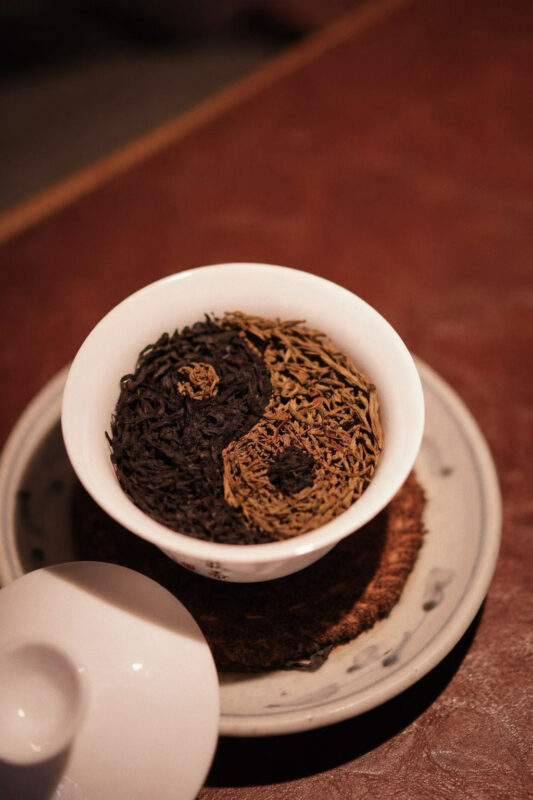
From a traditional Chinese medicine perspective, tea and food are often understood through qualities such as yin(阴), yang(阳), and qi(气). Teas that preserve more of their fresh, brisk character are often understood as more yin(阴) in nature. Teas shaped by roast, fuller oxidation, aging, or later fermentation are more often seen as more yang(阳).
In this view, digestion is an active and warming process. After a meal, qi(气) is moving as food is broken down and transformed. That is one reason many tea drinkers in China prefer teas with a warmer profile after meals, especially when the stomach already feels full, active, or under pressure.
A simple reference table
Tea style | TCM-style Nature | Usual processing direction | How it is often understood after meals |
|---|---|---|---|
Green tea | More yin (阴), cooler | Minimal oxidation, preserves fresh character | Often feels fresher and brisker, but may feel too cold or sharp right after eating |
Newly made white tea | Mildly yin (阴), slightly cool | Light processing, little oxidation | Can feel light and clean, but not always ideal when the stomach already feels full or active |
Sheng pu-erh | More yin (阴), cooler and more lifting | Sun-dried, minimally processed, not roasted | Often feels vivid and penetrating, but may feel too brisk for some people after meals |
Black tea | More yang (阳), warmer | Fully oxidized | Often feels rounder, warmer, and easier to receive after eating |
Aged white tea (3+ years) and other aged teas | Closer to neutral, with a gentler balance of yin (阴)and yang (阳) over time | Aging gradually changes the tea’s internal character | Often feels calmer, deeper, and more balanced after meals, and is usually considered easier to pair with both cooler and warmer constitutions than freshly made white tea |
Wuyi rock tea / Yancha | More yang (阳), warming | Roasted oolong, shaped by fire and oxidation | Often feels structured, warming, and suitable after heavier meals when brewed gently |
Dark tea / Heicha | More yang (阳), warm and settled | Post-fermented / aged | Often understood as more grounded and more compatible with a full stomach |
This traditional view does not replace personal experience. But it does offer a useful way to understand why many people in China instinctively reach for more roasted, aged, oxidized, or otherwise warming teas after meals.
What May Make Tea Feel Worse After Eating
A few things tend to make post-meal tea feel less comfortable:
- very strong infusions
- very fresh and brisk teas on a full stomach
- very cold tea immediately after a meal
- drinking too much, too quickly
- trying to “fix” fullness with a more concentrated cup
That last one is especially common. When tea feels too weak after food, the instinct is often to add more leaf, increase the time, or push the brew harder. But after eating, that often solves the wrong problem. The issue may not be that the tea is too light. The issue may be that the body is already too occupied for that level of intensity.
A Better Post-Meal Cup Is Usually a Better-Matched Cup
When tea feels too strong after eating, the answer is not always to abandon the tea or immediately switch to something else.
Sometimes the better first move is simpler: wait a little longer, reduce the leaf, keep the ratio lighter than 1:40, shorten the first infusion, drink in small sips, and choose a tea with a warmer and steadier profile.
In other words, start by adjusting the cup before blaming the tea.
If you are choosing between tea types, a gentler, warmer profile often works better after meals. For a more direct comparison, see Roasted Oolong vs Black Tea After Meals.
When the cup is adjusted to the moment, tea often returns to what it was meant to be — something that settles, rather than something that presses.
FAQ
Why does tea taste stronger after eating?
Because the tasting context has changed. After food, the palate is no longer neutral, and the digestive system is already active. In that setting, bitterness, astringency, thickness, and sharpness often stand out more quickly than sweetness or aroma.
Should I wait before drinking tea after meals?
For many people, yes. Waiting around 30 minutes often feels more comfortable than drinking tea immediately after eating.
How should I brew tea after meals?
Brew it lighter than usual. As a reference, keep the tea-to-water ratio lighter than about 1:40, shorten the first infusion, and avoid pushing the tea too hard in the first cups.
What kind of tea often feels easier after meals?
Many people find black tea, Wuyi rock tea, and aged white tea easier to drink after meals, especially when brewed gently.
Is cold tea a good idea after meals?
Often not. Very cold tea can feel more abrupt right after eating, especially when the stomach already feels full or tense.