- Best Seller
“Portable tea set for office &travel” has been added to your cart. View cart
- Tea Type
- Tea Ware
- Tea Pet & Garniture
- Mood & Health
- Gift Set
- Shop All
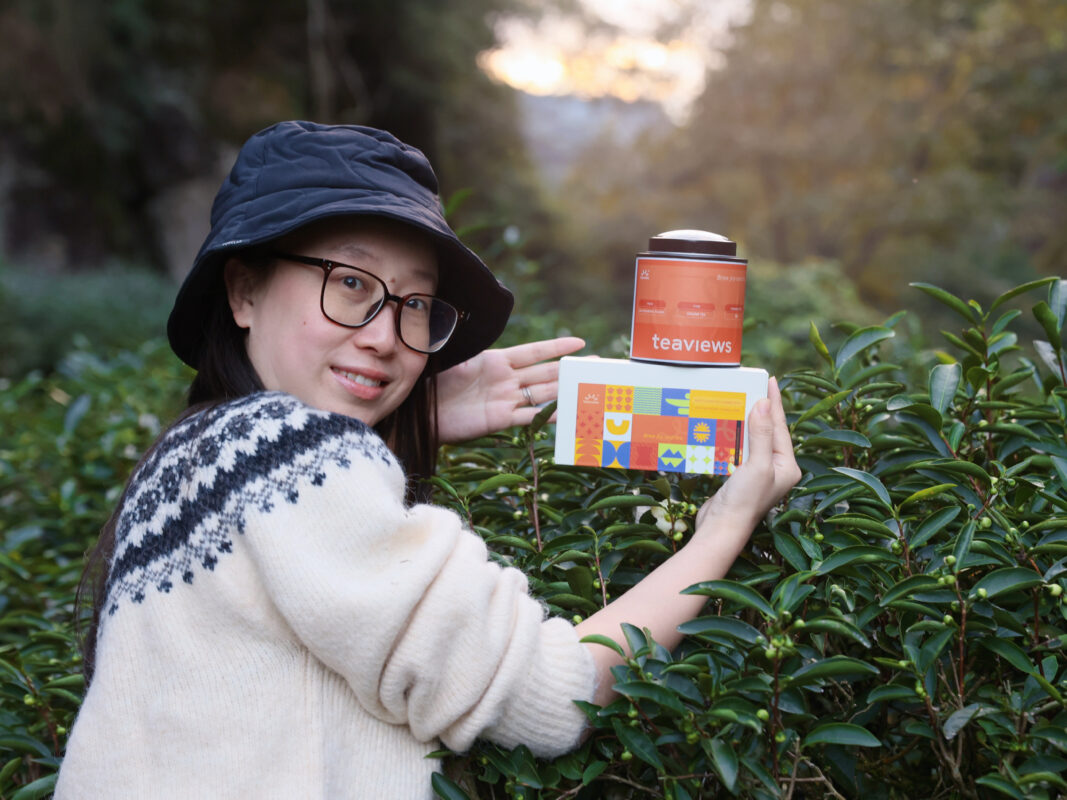
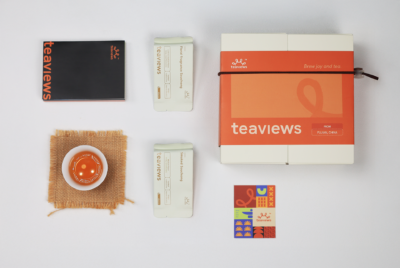
Misty peak treasure blended tea gift box
$81.00 – $155.00

More tea knowledge coming soon
In development
Something exciting is brewing!
Stay tuned for upcoming deals, and subscribe to be the first to know about exclusive offers on tea and teaware.
If you are just beginning to explore Wuyi rock tea, the first question is often not:
“Which tea is the best?”
It is usually a more practical one:
“Where should I begin?”
Wuyi rock tea, also known as Wuyi yancha, can feel complex when you first meet it. Roast, floral aroma, mineral character, sweetness, body, bitterness, and finish may all appear in one small cup. Without a reference point, it can be hard to know what you are actually tasting.
And if you ask a tea expert, the answer may become even more complicated. They may start talking about mountain origin, cultivar, tree age, Zhengyan, Banyan, or whether a tea is “real” rock tea — questions that often appear in online gongfu tea communities.
Worse still, you may try a Wuyi rock tea recommended by someone else, but your own experience feels disappointing. Then the confusion becomes even stronger:
“What happened? Why doesn’t this taste like what they described?”
At that point, it is easy to feel that Wuyi rock tea is simply too complicated.
But often, the problem is not you.
A beginner does not always need to start with the strongest tea. A beginner needs a tea clear enough to compare from. That is the role of a baseline tea.
It is a little like learning a formula in mathematics. When many variables are changing at the same time, you need one stable structure first. Once you understand the basic formula, you can apply it through your own experience instead of only watching how someone else solves the problem.
A baseline tea gives your palate a middle point. Once you understand what a balanced Wuyi rock tea feels like, it becomes easier to notice what is softer, sweeter, more floral, more mineral, or more structured.
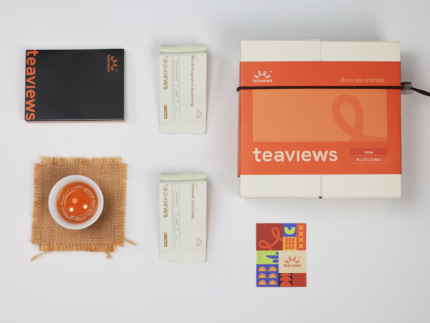
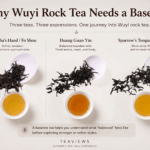
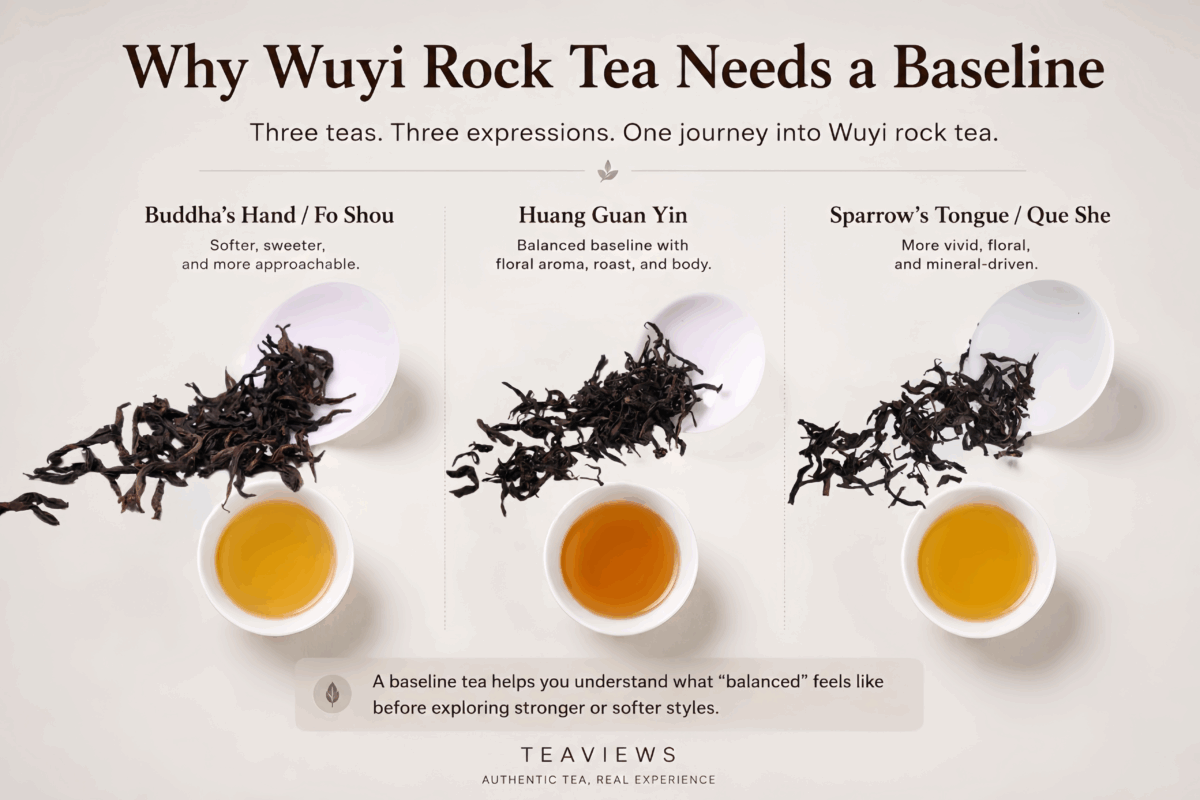
At Teaviews, this is the idea behind our Yancha Baseline Set. Huang Guan Yin works as the baseline reference. Fo Shou shows a softer and sweeter direction. Que She shows a more vivid and structured expression.
Together, they create a simpler path into Wuyi rock tea.
Not by making yancha shallow, but by helping you understand it slowly through contrast.
The best Wuyi rock tea for beginners is usually not the strongest, rarest, or most expensive tea.
A better starting point is often a tea that is balanced, clear, forgiving in brewing, and able to work as a baseline.
A baseline tea helps you first understand roast, aroma, body, mineral character, and finish. After that, it becomes easier to compare softer, sweeter, or more structured Wuyi rock tea styles — especially when the tea does not punish every small brewing mistake.
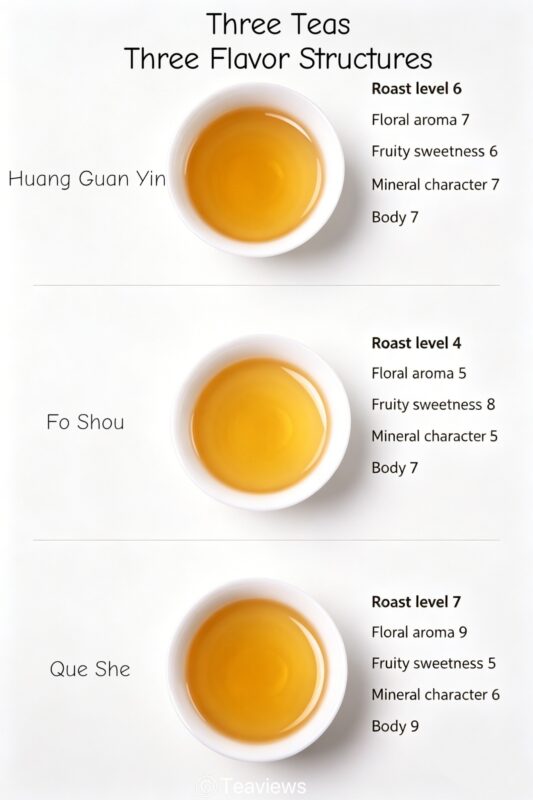
In the Teaviews Yancha Baseline Set, Huang Guan Yin plays this reference role. It offers controlled floral aroma, medium roast balance, moderate body, sweet fruit character, and a brewing tolerance that is friendly to beginners.
Wuyi rock tea is not difficult because it is mysterious. It becomes difficult when you do not yet have a reference point.
Many beginners first notice the roast. Then they notice floral aroma, warmth, bitterness, body, or mineral texture. But when these layers appear together — and when cultivar, roast, origin, and brewing also influence the cup — it can be hard to separate them.
Sometimes, a tea is not simply “too strong.” It may have been steeped a few seconds too long.
Sometimes, a tea is not simply “too bitter.” Its structure may need better guidance to unfold.
Sometimes, a tea is hard to remember. It only needs to be compared with a steadier tea, and suddenly the differences become clearer.
So the best way to understand Wuyi rock tea is not always to judge immediately whether it is “good” or “bad.” A better first step is to build a small tasting reference.
One tea becomes the center. One tea moves in a softer direction. One tea moves in a more vivid and structured direction. Then the whole category becomes easier to read.
For a broader introduction to how yancha tastes, you may also read our Wuyi Rock Tea Taste Guide.
A common misunderstanding is that the first Wuyi rock tea should be the most famous, the strongest, or the one with the biggest story.
That is not wrong. But it may require some foundation in taste, knowledge, and experience before the tea can truly “land” in the right place.
For beginners, the best starting point is often not the tea with the most power. It is the tea with the clearest structure.
Wuyi rock tea has many variables: roast, cultivar aroma, leaf structure, oxidation, fire level, brewing time, water temperature, cultivar character, and mountain environment.
If your first tea is too strong, you may only remember bitterness, heaviness, or pressure. Its deeper beauty may be covered.
If your first tea is too light, you may not feel what separates Wuyi rock tea from other oolong teas. Many beginners are still learning how to distinguish Phoenix dancong, Wuyi rock tea, and Taiwanese oolong — and that is completely normal.
A good beginner tea should sit somewhere in the middle. It should have enough roast to tell you this is rock tea.
Enough aroma to be memorable — such as the orchid-like and fruity notes often found in Wuyi teas.
Enough body to give the tea structure and express the “rock” character. And enough brewing tolerance that a small mistake does not ruin the cup.
This kind of tea gives you a gentle kind of surprise. More importantly, it leaves a lasting impression. It becomes a foundation for comparison.
A baseline tea is a tea used as a reference point. It helps you understand the middle ground of a tea category before comparing other styles.
In Wuyi rock tea, a baseline tea should show enough roast, aroma, body, and finish to express the basic structure of yancha, while still being friendly enough for beginners.
Without a baseline, every tea feels separate. You may like one tea and dislike another, but you may not know why.
With a baseline, comparison becomes clearer. You can begin to say:
At that point, drinking tea begins to become understanding tea.
Not in a heavy or academic way, but through tasting, returning, comparing, and slowly seeing the simple variables that you can actually control.
Da Hong Pao is often the first name people hear when they discover Wuyi rock tea. It is famous, important, and almost equal to the idea of yancha for many people.
But Da Hong Pao is not the only doorway into Wuyi rock tea.
For beginners, the most famous tea is not always the easiest place to begin. Da Hong Pao can be a meaningful place to arrive at, but it is not always the clearest first reference point.
One reason is that in Wuyi tea, Da Hong Pao can refer to a specific cultivar, but it can also refer to a blended style or a certain taste profile. If you drink one Da Hong Pao and assume that all Da Hong Pao should taste exactly like that, you may be led in the wrong direction.
You can learn more in our Da Hong Pao Tea Guide.
A beginner baseline is chosen for a different reason. It is not chosen because it has the biggest name. It is chosen because it helps you understand the structure of Wuyi rock tea more clearly: roast, aroma, body, mineral character, brewing tolerance, and finish.
This is why a set built around carefully selected Huang Guan Yin, Fo Shou, and Que She can be meaningful. These names may be less familiar than Da Hong Pao, especially outside China. But together, they create a clearer tasting path.
Huang Guan Yin gives the reference.
Fo Shou moves toward the softer and sweeter side.
Que She moves toward the more vivid and structured side.
This approach does not begin with reputation. It begins with comparison.
Once you understand the baseline, your next step into famous teas like Da Hong Pao may become much easier.
This question is very natural.
There are thousands of Wuyi rock tea cultivars. Beyond the most famous names, many teas are unfamiliar to drinkers outside China. Huang Guan Yin, Fo Shou, and Que She were selected here not because they are the most famous, but because they give beginners a clearer tasting direction.
Huang Guan Yin works well as a baseline because it sits close to the middle of the Wuyi rock tea experience.
It is a cultivar developed by the Tea Research Institute of the Fujian Academy of Agricultural Sciences. Its strengths are easy to recognize:
It has strong floral presence, with a clear gardenia-orchid style of Eastern floral aroma.
It has body, and the roast level we choose is balanced enough to support a long, sweet finish.
It has structure, while reducing bitterness and astringency as much as possible, making it friendly to beginners.
This matters for new drinkers.
If the first tea is too strong, the drinker may only notice pressure. If the first tea is too soft, the drinker may not understand where the structure of Wuyi rock tea comes from.
Huang Guan Yin offers a steadier middle ground.
In the Yancha Baseline Set, Huang Guan Yin is not chosen because it is the loudest tea in the set. It is chosen because it is stable enough to become a reference.
Taste Huang Guan Yin first. Then taste the other two teas. Then return to Huang Guan Yin.
That return is important.
After Fo Shou, Huang Guan Yin may feel more structured. After Que She, Huang Guan Yin may feel more balanced. After both, its role becomes clearer.
This is the quiet usefulness of a baseline. It does not have to amaze you in the first sip. It helps you understand what is happening.
A baseline only becomes truly useful through comparison.
That is why this set does not place three very similar teas together. The purpose is not to repeat the same experience three times. The purpose is to show how Wuyi rock tea can move in different directions while still belonging to the same family.
Fo Shou shows the softer side of Wuyi rock tea.
Compared with Huang Guan Yin, it usually feels rounder, sweeter, and easier to approach. Its roasted warmth is lighter, and the mouthfeel can feel softer. Some drinkers may notice a gentle fruit impression, similar to the clean freshness of snow pear, resting under the warm roasted character.
Fo Shou is helpful for beginners because it answers a simple question:
What does a softer Wuyi rock tea feel like?
It does not remove the identity of yancha. It simply shows a gentler, more relaxed side of the category.
If you worry that rock tea is always too strong or too heavy, Fo Shou may help you see that yancha can also be soft, sweet, and comfortable.
Que She moves in another direction.
Compared with Huang Guan Yin, it feels more vivid, more floral, and more structurally present. Its mineral expression is clearer, and the aroma may lift more sharply. It is also more sensitive to over-extraction, which means brewing time matters more.
This is helpful for learning.
If a few extra seconds make the cup more bitter or more astringent, Que She shows how structure and brewing are connected.
For beginners, this does not mean Que She is “too difficult.” It simply asks you to pay more attention.
Shorter infusions.
Cleaner pouring.
Less distraction while brewing.
When you approach it carefully, Que She helps you see how Wuyi rock tea can become more vivid and expressive without becoming vague.
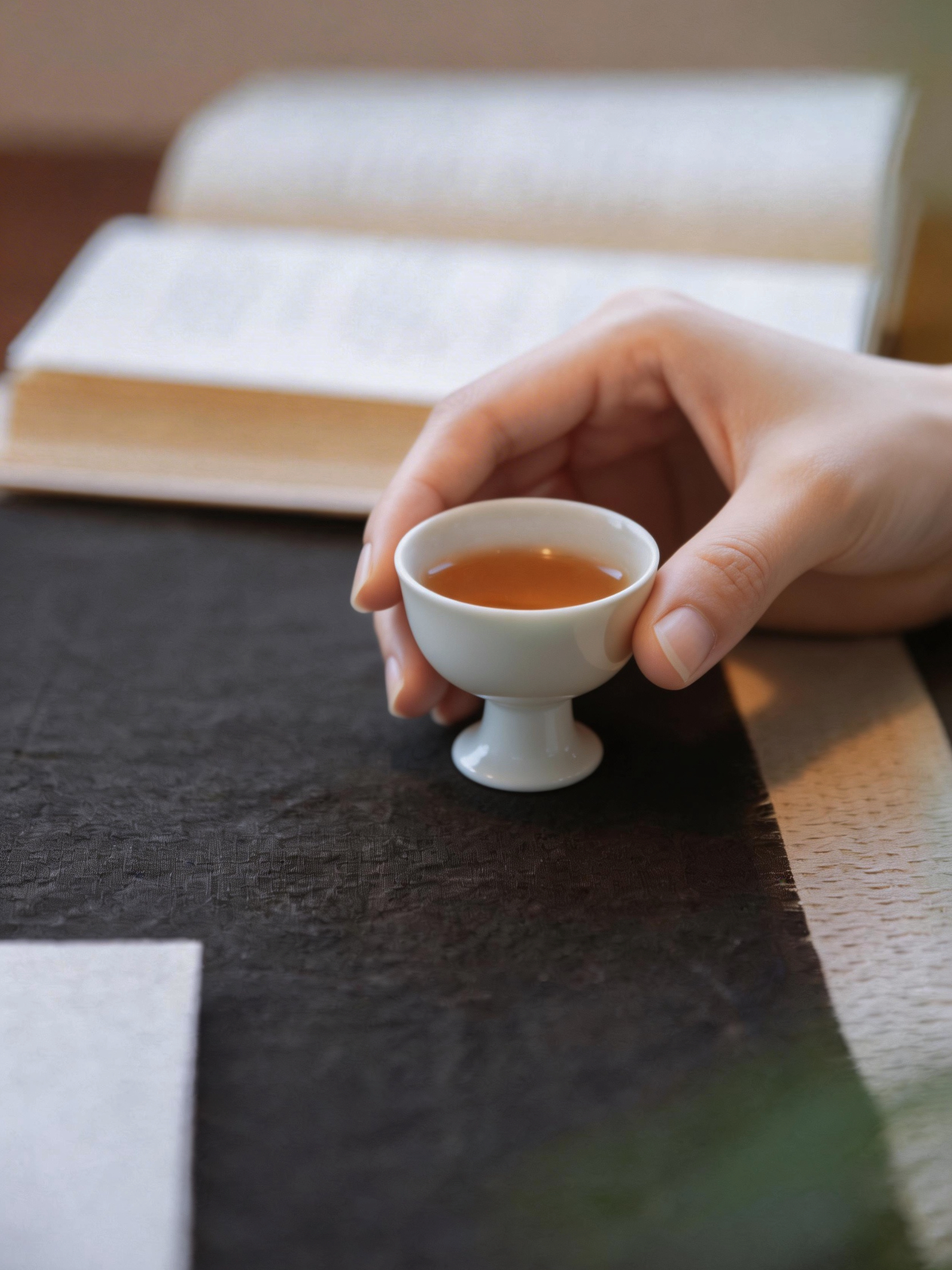
For your first tasting, do not rush to brew the strongest cup. Start by brewing a clear cup.
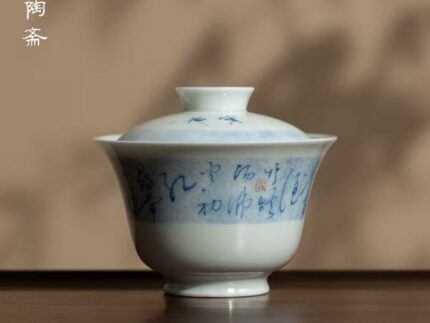
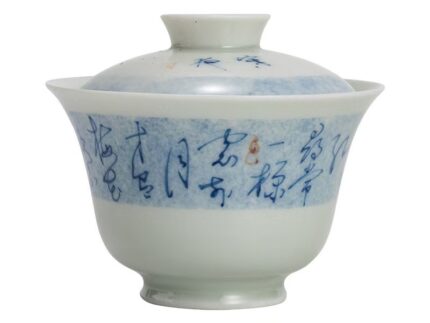
If you have a white porcelain gaiwan, it is a good place to begin. A 100–120ml gaiwan works well for small gongfu tea sessions. When comparing several teas, the simpler and more consistent your method is, the easier it is to notice the differences.
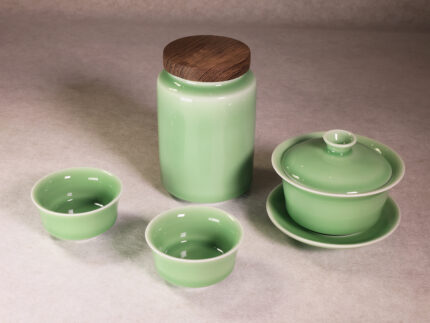
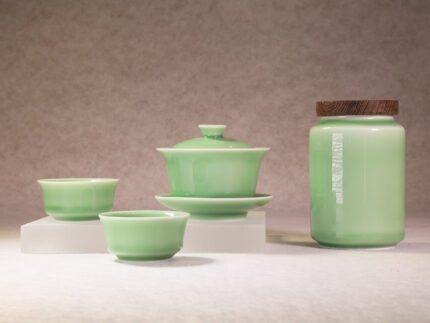
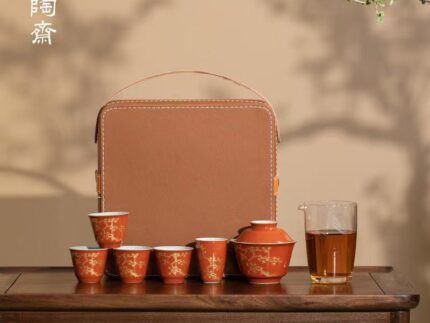
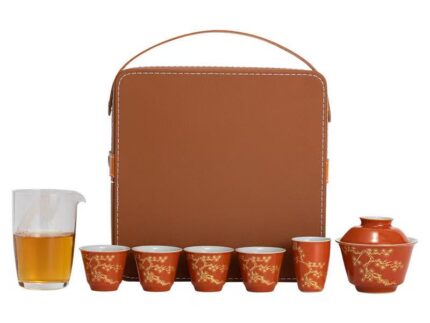
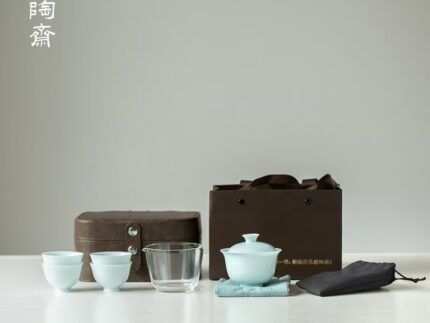
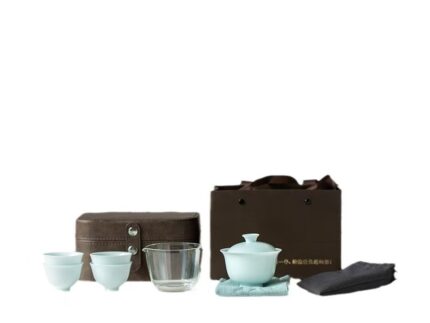
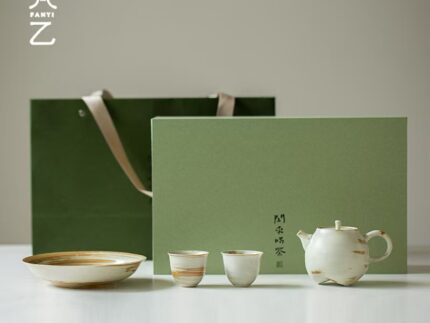
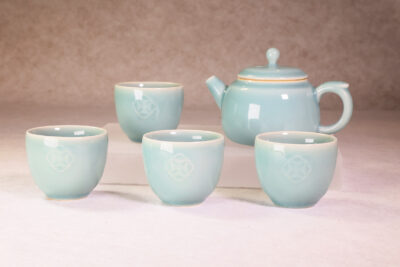
You can also use a compact set like our Portable Gongfu Tea Set for a simple Wuyi rock tea tasting session.
A beginner-friendly method:
Use hot water.
Use short infusions.
Pour cleanly.
Taste the first two or three infusions before judging the tea.
If the tea feels too strong, shorten the next infusion first instead of changing every variable at once.
The goal is not to force all the strength out of the leaves. The goal is to see the differences clearly.
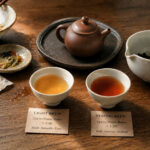
Huang Guan Yin should feel steady and moderate. Fo Shou should feel softer and sweeter. Que She may feel more vivid and more sensitive to timing.
When you compare them under similar conditions, the structure becomes easier to read.
If you already know exactly what kind of Wuyi rock tea you like, one tea may be enough.
But if you are still learning, a tasting set is often more helpful.
One large bag of a single tea gives you repetition. Repetition has value, but it does not always give comparison.
A structured tasting set gives you contrast. It helps you understand not only whether you like a tea, but why.

A good beginner tasting set should have a clear logic.
One tea as the baseline.
One tea showing a softer expression.
One tea showing a more structured expression.
This means you are not drinking three random teas. You are learning how Wuyi rock tea changes.
That is the role of the Teaviews Yancha Baseline Set: a practical Wuyi rock tea tasting trio designed to help beginners understand yancha through comparison. It is not designed as a rare collector’s set. It is more like a daily reference set. You can return to it again and again while building your own understanding of roast, aroma, mineral structure, sweetness, body, and brewing rhythm.
If you are choosing your first group of Wuyi rock teas, the Yancha Baseline Set gives you more than one guess. It gives you three reference points you can compare.
Wuyi rock tea does not need to feel distant at the beginning.
You do not need to understand every cultivar, every roast level, or every mountain story right away. You also do not need to begin with the most famous name or the strongest cup.
Sometimes, the better beginning is simpler — something you can purely enjoy.
Start with a balanced tea. Notice what stable rock tea feels like. Then compare what becomes softer, sweeter, sharper, more floral, or more structured.
A baseline does not reduce the depth of Wuyi rock tea. It gives you a way to enter it.
Once you have a clear reference point, the rest of the mountain becomes easier to walk into.
The best Wuyi rock tea for beginners is usually a balanced rock tea that can work as a reference point. Instead of starting with the strongest or most famous tea, beginners may benefit from a tea that clearly shows roast, aroma, body, mineral character, and finish without feeling overwhelming.
Da Hong Pao is one of the most famous Wuyi rock teas, but it is not the only starting point. Some beginners may find it easier to begin with a balanced baseline tea first, then compare other Wuyi rock tea styles afterward.
A baseline tea is a tea used as a reference point. It helps you understand the middle ground of a tea category before comparing softer, stronger, sweeter, or more aromatic styles.
These three teas create a clear tasting contrast. Huang Guan Yin works as the baseline reference. Fo Shou shows a softer and sweeter direction. Que She shows a more vivid, floral, and structured expression. Together, they help beginners understand Wuyi rock tea through comparison.

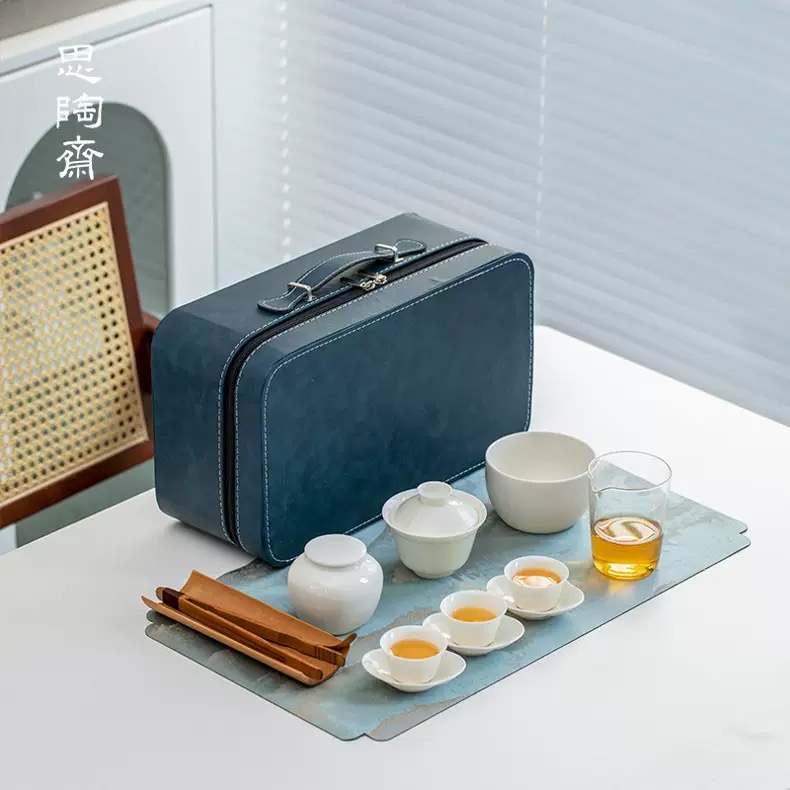
Beginners can start with a white porcelain gaiwan, hot water, and short infusions. If the tea feels too strong, shorten the next infusion before changing too many variables. The goal is not to brew the strongest cup, but to brew a clear cup that is easy to compare.