

















Black Tea or Rock Tea After Meals? How to Choose Based on Food, Body State, and Occasion

Intro
People who have a habit of drinking tea after meals often spend a long time thinking about which tea to choose. Because once “a tea that tastes good” is placed in the after-meal setting, the question becomes more specific: after drinking it, the body should feel right.
But what does that “right” actually mean? Does the body need to be warmed and held? Does it need help moving through the greasy, heavy, overfull feeling more quickly? Or does it need help bringing back the attention that digestion quietly pulls away?

Black tea and roasted oolong — especially Wuyi rock tea — are both very good after-meal choices. When people ask me which one is better, I usually ask them something else first: what did your body want at that moment? These teas are already different from the beginning, and that difference shows up directly in the cup: how the aroma rises, where the bitterness lands, how the liquor moves, and how the body receives it. Even if many people happen to drink black tea after meals, that still does not mean black tea is automatically the best fit for you in that moment.
So this article is not really trying to answer the question, “Which is better, black tea or rock tea?” It is trying to answer a more useful one: after a meal, which one fits the state you are actually in?
If you want the more basic explanation for why tea can feel comforting after meals in the first place, you can start with Why Tea Feels Settling After Meals. This article goes one step further: when you really do want to choose between black tea and rock tea after food, what is fundamentally different about them, and how should you decide?
1. Why Black Tea and Rock Tea Were Never the Same Thing to Begin With
Before they become “after-meal teas,” they are simply two very different teas.
Black tea is fully oxidized. During processing, the compounds in the fresh leaf that feel more direct, fresher, and more forward-moving are reorganized. Part of the tea polyphenol system is transformed further, forming compounds such as theaflavins and thearubigins. Put more simply: in the cup, this often shows up as a darker liquor, a more continuous texture, and a rounder arrival. It does not usually rush to the front of the mouth to grab attention.
Rock tea is different.
It belongs to the world of semi-oxidized oolong, but it also carries obvious roast. It is not on the same path as black tea. Instead of becoming round in that way, it keeps more of its frame, then layers roast-derived aromatic tension and structure on top. So in the mouth, rock tea usually feels more three-dimensional: the aroma rises more easily, the roast, mineral feel, and astringent edge are easier to notice first, and the liquor has more movement, more shape, and more corners to it. But at the same time, its presence in the body can linger longer.
In other words, the difference between black tea and rock tea does not appear only after a meal.
Their processing has already decided how they will speak in the cup.
Black tea tends to draw its force inward and downward.
Rock tea tends to lift its force up and outward.
After a meal, the body simply amplifies that difference.
2. Why That Difference Becomes More Obvious After a Meal
After a meal, tea is no longer entering a blank mouth or a quiet body.
The traces of the meal are still there: oil, sweetness, spice, acidity, meatiness, starch, seasonings. All of these change the order in which the mouth receives flavor. At that point, the smaller sweetness, softer floral notes, and more delicate layers often do not come forward first. What usually appears earlier instead are bitterness, roast, thickness, astringency, stimulation, and dryness.
At the same time, the stomach and intestines are already working. Food is being broken down. Stomach acid and digestive enzymes are already active. Motility is already moving. So what the body is receiving now is no longer only, “Does this tea taste good?” It is also: is this cup helping me move through this meal, or is it adding more on top of it?
This is exactly where black tea and rock tea begin to take different roads.
Black tea after a meal usually does not announce itself all at once. What people more often notice is that the stomach slowly warms, that the hard, cool, slightly abrasive feeling after food softens a little, that the faint sense of bloating drops lower, and that the body lets go a little. It is not trying to split the meal open immediately. It is more like it is helping carry the body out of that after-meal state.
Rock tea is usually felt earlier.
The aroma rises first, then the roast and the structure show themselves, the oily coating in the mouth pulls back faster, the tightness in the chest and upper stomach loosens a little, and the mind clears more quickly. But the boundary of this “quick arrival” is also very clear: if the tea is pushed too hard, if it is drunk too fast, or if the body is already on the dry or sensitive side, that same “oil-cutting” force can turn into dryness, slight reflux, or that strange hollow feeling inside.
So the real question after a meal is not “Which tea is better?” but this:
At this moment, is the body resisting coldness, or resisting greasiness?
3. Black Tea After Meals: Warmer, More Gathering, More Like Something That Holds the Body
Black tea is not really for those after-meal moments when all you want is to cut through grease immediately.
It is more suitable for moments like these:
- after cold dishes or raw food, when the stomach feels slightly chilled
- when the meal is over, but the body does not feel oily so much as a little weak, a little bloated, and a little unwilling to move
- when the digestive system is delicate, and strong tea on an empty stomach is already hard to tolerate
- when the meal is over and the next movement is not socializing, but slowly returning to yourself, to quiet, or to concentration
What black tea offers after meals is usually not a “strong performance.”
It is more like this:
- the stomach slowly warms
- the slight bloating does not burst apart, but gradually softens
- there is no obvious “cutting grease” sensation, but the whole body feels a little easier
- there is some lift, but it does not come up all at once
- the body warms a little, and the hands and feet are less cold
It does not cut the meal apart.
It catches that half-empty, half-cool, half-tired state after the meal and holds it.
This is one reason many people feel that black tea is more “stomach-friendly” after meals.
Not because it magically “heals the stomach,” but because after meals it often does not arrive first as stimulation. Instead, it is often received as something softer — gentle, warm, steady, and moving downward with the body.
From the processing side, that also makes sense.
With fuller oxidation, the sharper and more direct bitter structure of the fresh leaf has already been reorganized. So what often appears in the cup is depth, roundness, and continuity, rather than freshness, edge, or frontal force.
After a meal, that difference becomes very obvious.
If the meal is over, but the person has not really come back yet, what may be needed is not the more forceful tea, but the tea that knows how to hold you.
4. Rock Tea After Meals: More Opening, Faster, More Like Breaking Open What Feels Stuck
Rock tea is better suited not to weakness and coolness, but to thickness and blockage.
It usually fits after-meal states like these:
- after grilled food, fried food, fatty meat, sweet-rich food, or heavy flavors
- when the mouth still feels oily and the flavors of the meal are still hanging there
- when the chest and upper stomach feel slightly tight — not cold, but blocked
- when the body does not want to fold inward, but needs to be opened a little
- when the meal leads into conversation, gathering, and continued attention
Rock tea usually does not wait long before you notice it after a meal.
What often happens is:
- the tea energy rises as soon as it enters
- aroma, roast, and structure show up first
- the oily coating in the mouth starts to recede faster
- the chest and upper stomach feel a little more open
- the mind becomes clearer more quickly, and speech and attention come back more obviously
- that feeling that “this meal is still sitting inside the body” starts to break apart
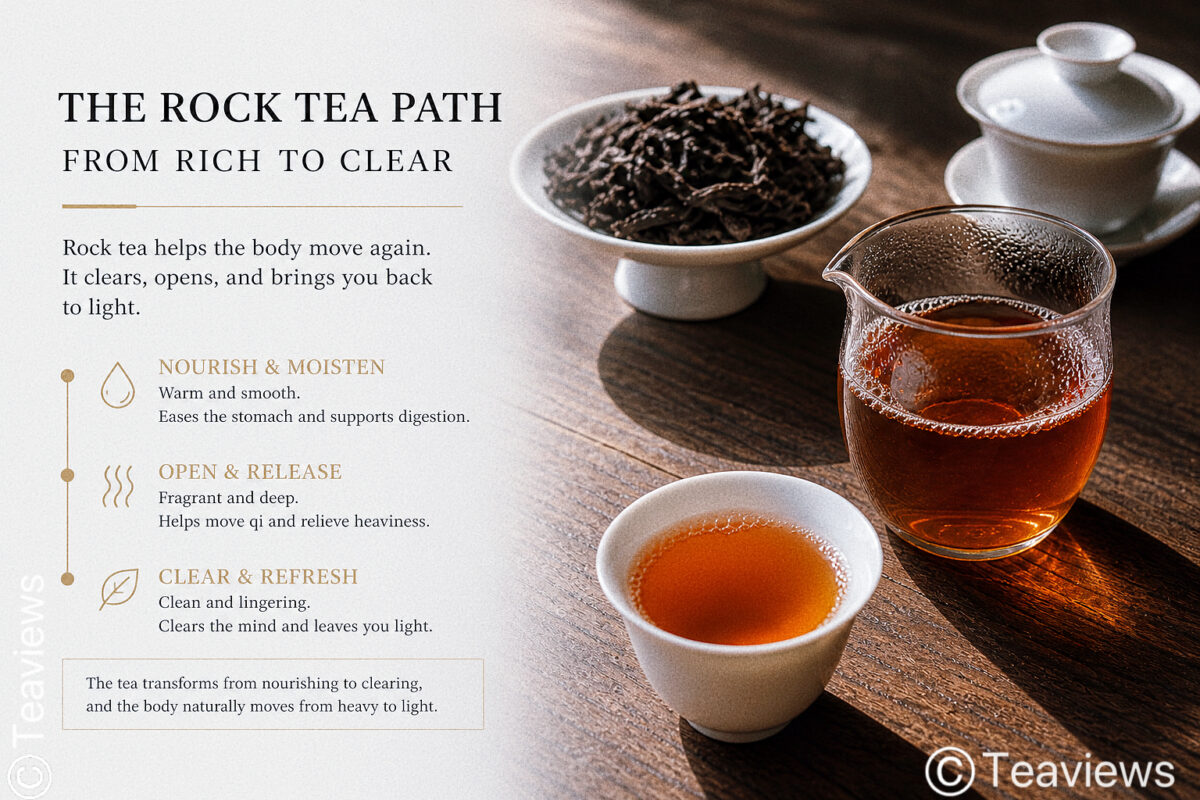
It is not there to soothe you.
It is more like it takes what feels stuck and starts pushing it outward.
That is also why many people describe rock tea after meals as “degreasing” or “cutting the heaviness.”
That “cutting” is not just that the mouth feels less oily. It is that the sticky, heavy, stagnant feeling after a meal is dispersed faster.
But the boundary matters.
Rock tea is not suitable after every meal.
If it is taken on an empty stomach, if the stomach is already sensitive, if it is gulped down immediately after eating, or if the brew is pushed too strong and too fast, it can easily shift from “opening” to “drying.” Dry mouth, slight reflux, a hollow feeling inside, even a touch of palpitations — none of those are impossible.
What makes rock tea good is not gentleness.
Its strength is precisely that it knows how to break heaviness, cut grease, move qi, and split open that thick after-meal feeling.
If this is the kind of tea profile you prefer after meals, you can explore our Wuyi rock tea selection.
If you want a more structured way to compare different expressions of rock tea, the Yancha Baseline Set is a more practical place to start.
5. Looking at What You Ate Is Often More Useful Than Looking at the Tea Name First
Very often, the first thing to look at when choosing between black tea and rock tea is what the meal left behind.
After-meal foods and states that fit black tea better
- cold food
- raw food
- meals that are cooler in nature
- meals that are light, but still leave the stomach feeling empty or cool
- eating in a cold environment
- meals that are not especially oily, but after which the whole body feels a little weak, a little cool, and not wanting to be lifted again
In this case, the problem is not that the grease will not dissolve. It is that the meal is over, but the stomach and body have not been held.
Black tea is useful here not because it “cuts oil,” but because it can slowly warm the middle and carry the body out of that after-meal state.
After-meal foods and states that fit rock tea better
- grilled food
- fried food
- fatty meat
- high-oil, high-sugar, highly spiced, richly flavored food
- rushed eating with little proper chewing
- meals after which the mouth still feels coated, the chest still feels full, and the head feels slightly cloudy
Here, the problem is not coldness, but residue.
The mouth still has it.
The chest still has it.
The upper stomach still has it.
This is where rock tea is more likely to “cut in” and move that thickness downward.
So the more useful question is not:
Which is better, black tea or rock tea?
It is:
Did this meal leave the body with coolness, or with greasiness?
If it left coolness, choose black tea.
If it left greasiness, choose rock tea.
If you want a fuller after-meal scenario guide, you can also read Best Tea After a Heavy Meal.
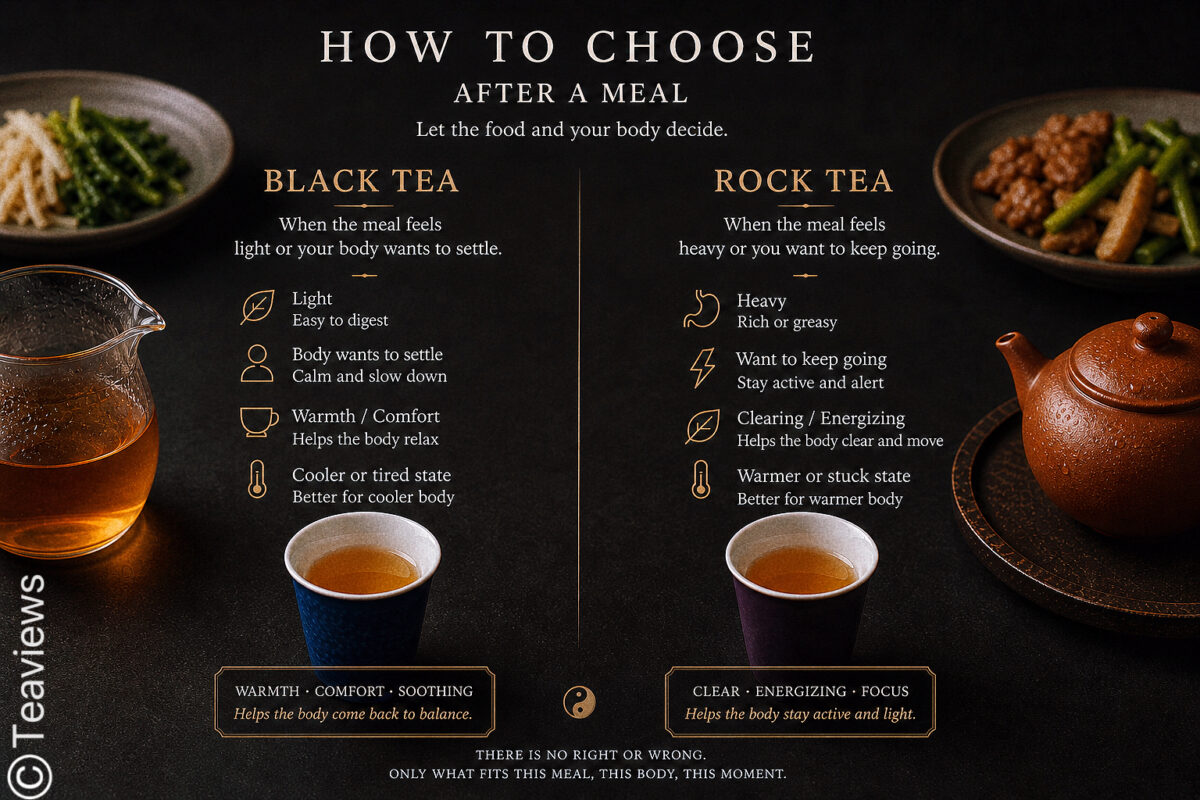
6. The Same Meal Can Still Lead Different Bodies to Different Teas
Even when two people eat the same table of food, their tea choices after the meal may still be different.
Body states that lean more toward black tea
- spleen-stomach deficiency coldness
- a cool feeling in the stomach after eating
- hands and feet that get cold easily
- looser stools and a more sensitive digestive system
- not much food was eaten, but appetite is already gone
- a need for a slow transition out of the meal rather than being lifted too fast
This kind of body is not always afraid of oil. More often, it is afraid of being stimulated again.
Black tea works better here because it does not require the body to open immediately. It gives a little warmth first, then a little holding.
Body states that lean more toward rock tea
- a more solid, excess-type constitution
- a tendency to feel blocked, greasy, or unable to clear heaviness after meals
- frequent eating of rich food and meat, especially mixed heavy meals
- not really a “cold” type, but a body that tends to accumulate, hold, and overheat
- after meals, what is needed is clarity and opening rather than soothing
This kind of body often does not need warming first. It needs movement.
Rock tea works better here because it arrives faster and is better at breaking up that post-meal stagnation.
This should be said clearly:
This is not a constitutional diagnosis.
It is simply a very everyday, experience-based framework for choosing tea.
7. The After-Meal Occasion Also Changes Which Tea Fits Better
Even after the same meal, different settings can change which tea makes more sense.
Black tea suits these after-meal moments better
- drinking alone
- the meal is over and you are getting ready to return to yourself
- the afternoon still includes work, reading, or writing
- autumn and winter
Black tea lets the meal settle gradually in a warm, fragrant softness, and lets the person return more gently to their own bodily state, emotional state, and concentration.
Rock tea suits these after-meal moments better
- after-meal gatherings
- drinking with several people
- conversation is still moving
- the tea table will continue for longer after the meal
Rock tea suits these occasions because it is another extension of the meal itself.
It clears the mouth more easily, wakes the people at the table up more quickly, and lets the gathering keep flowing.
This distinction is very real:
Black tea is often better at helping a meal come to rest.
Rock tea is often better at letting a meal keep moving.
8. The Simplest Rule: If the Body Needs Warming, Choose Black Tea. If It Needs Opening, Choose Rock Tea
If after a meal the body needs:
- warmth
- slowness
- gathering
- warmth in the abdomen
- a gradual return from the meal back into itself
then black tea is usually the better fit.
If after a meal the body needs:
- opening
- cutting through greasiness
- breaking heaviness
- clearer wakefulness
- a way to split through what still feels thick and stuck
then rock tea is usually the better fit.
In the end, what you are choosing at that moment is not “the more refined tea,” but this:
How does the body need to be treated right now?
9. And Finally: Even If You Choose the Right Tea, Brewing Can Still Make the Judgment Wrong
Choosing the right tea does not mean the cup cannot still go wrong.
If black tea is brewed too strong after a meal, the warmth and holding it should have offered can turn into dry mouth, rising heat, and too much astringency.
If rock tea is brewed too hard after a meal, the opening and oil-cutting it should have offered can turn into reflux, palpitations, dryness, or discomfort in the upper stomach.
So for both of these teas after food, it is usually better to:
- wait a little before drinking
- keep the tea-to-water ratio lighter
- keep the first infusion shorter
- drink in smaller sips instead of pushing cup after cup too quickly
If you often find that “the tea choice was right, but the cup still felt too strong after the meal,” you can continue with Why Tea Feels Too Strong After Eating — and How to Brew It More Gently.
FAQ
Which is better after meals, black tea or rock tea?
Neither is better for everyone. Black tea fits better when the body needs warmth, softness, and gathering. Rock tea fits better when the post-meal state is oily, blocked, and in need of opening.
Is black tea gentler after meals?
In many cases, yes. It is more likely to be received after food as warmth, continuity, and downward movement, especially for people who feel cool, weak, or sensitive in the stomach.
Is rock tea better after rich or meat-heavy meals?
In many cases, yes. Especially when the mouth still feels oily and the chest and upper stomach still feel full, rock tea is more likely to make the body feel clearer and more open.
Can rock tea feel too strong after meals?
Yes. If taken on an empty stomach, drunk immediately after eating, or brewed too hard, it can become drying, reflux-inducing, or overstimulating rather than relieving.
Does brewing still matter even after choosing the right tea?
Very much. After-meal tea often feels wrong not because the tea category was wrong, but because the strength was wrong. A lighter ratio, a shorter first steep, and smaller sips all change how the cup is received.